
AIDE Platform Overview
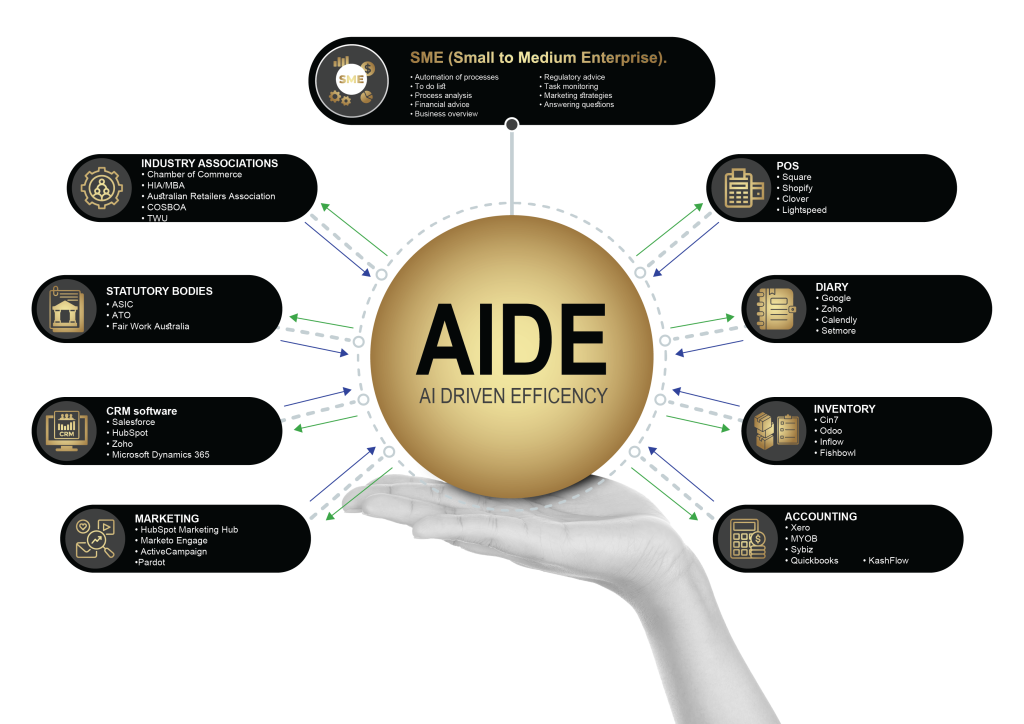
AIDE connects to the systems SMEs already use and unifies their financial, operational, customer, and compliance data into a single, intelligent layer. The diagram below illustrates how AIDE ingests information, processes it through AI, and delivers real-time insights back to the business.Eight Areas Where AIDE Strengthens SME Performance
AIDE consolidates information from key business tools and transforms it into practical, real-
time support across eight operational pillars. Each pillar represents a critical business
function prone to failure, inefficiency, or scattered data — AIDE brings them together.
The AIDE Intelligence Process
1. DATA IN: Connecting to Business Systems
AIDE links to existing SME tools — accounting, payroll, POS, CRM, rostering, banking,
compliance portals and more.
Goal: Pull accurate real-time business activity.
2. AI PROCESSING: Interpreting the Activity
Machine learning models analyse patterns, identify risks, highlight trends and compare
historical behaviours.
Goal: Understand what is happening, why, and what will happen next.
3. INSIGHTS OUT: Business-Ready Actions
AIDE delivers clear, context-specific recommendations — financial, operational, customer
and compliance.
Goal: Help owners make faster, more confident decisions.
AIDE Gives SMEs a Clear, Connected View of Their Business
Most SMEs rely on multiple apps, but none of them connect in a meaningful way. AIDE becomes the intelligence layer across all of them — turning fragmented data into clarity, action, and stability. Owners no longer have to:
-Check five different dashboards
-Guess at financial or operational trends
-React late to problems
-Hope they are compliant
-Try to make decisions with incomplete information
AIDE fills those gaps automatically.
Explore How AIDE Works in Each Area
Explore How AIDE Works in Each Area